Monday, May 27, 2013

“Elizabeth Taylor stayed here”… and so did I!


New deck at Chobe Game Lodge, notice the king fisher on the corner
Sitting on a newly built deck on the edge of the Chobe River in a comfy low seated chair on a poofy cushion with my feet up on a foot stool, I can see all the Chobe National Park has to offer. In front of me I see warthogs, impala, puku (a rare antelope only found in the Chobe region), baboons, elephants, crocodiles, monitor lizards and an array of water birds to keep any birder happy (egrets, darters, fish eagles). Armed with my new Leica binoculars, that Paul bought me for my birthday and anniversary celebrations this year (they’re very nice binoculars), I could sit for hours just watching what happens to roam or fly in front of me. It is magical!

After a recent trip to the Chobe National Park I have a completely different impression of the park than I had in the past. Typically we drive into the park for a day trip and cruise around the breath-taking sights of the Chobe River front but we are always on the move. I’ve never actually stayed in the park and doing so left me with a completely different impression of the peacefulness of the place.


Peaceable kingdom - warthog, impala and puku
Heron, darter and monitor lizard (on log to left)

We were invited up to help map some of the new, and more remote, areas of the Chobe National Park as the part of a new park management plan. For years the riverfront has been congested by the ever growing number of tour operators who want to show their clients the “best” views. At times, on previous trips to the park, it has felt like a traffic jam of safari vehicles…not so much fun. So we are very much in support of efforts to reduce the congestion by making alternative routes to other areas of the park. The Wildlife Department has put in four new water holes and a road system is developing around them that needed to be mapped. We literally drive with our GPS, gather the data and Paul “makes” the map when we get back to the office (using GIS – geographic information systems). At one of these new water holes, we saw an amazing collection for elephants and sable in the middle of the day (beautiful dark brown antelopes with crescent shaped antlers).

Bedroom Chobe Game Lodge
While we had originally assumed (or at least I had assumed) we would be camping for three nights while mapping, we actually ended up staying at Chobe Game Lodge  – one of the premier safari lodges in Botswana and the only one located within Chobe national park (all the other lodges in the area are in Kasane, the town that borders the park).

We were treated to three nights of luxury, as Paul is friends with the owner, who he was doing the mapping for. The lodge is done in a North African style (it looks more like Morocco than Botswana) with guestrooms housed in buildings with a series of arches with lovely dark wood furniture and elaborate decorative materials throughout. Our room included a comfy king size bed (that you had to have a running start to get up into) and a lovely veranda that overlooked the Chobe River.


Veranda, Chobe Game Lodge

View from veranda, Chobe Game Lodge

And as you might have guessed from the title of this blog, Elizabeth Taylor did stay here once when she married Richard Burton (maybe for the second time?). I would highly recommend it as a honeymoon spot…if you can afford it (this time of year it is over $1000/person/night!). 

Dinner included a delicious buffet that was situated in a slightly different venue each night: one night in the main restaurant area, another out in the open patio area by the warm light of multiple candelabras on each table, and for our final night we were seated on a grassy “boma” area right on the riverfront. A boma is a traditional space where people gather for a braai (what we would call a “cook out” or barbeque). We ate under the stars to the sound of marimbas and singing by locals. It was stunning!

On our final evening while driving back to the lodge at sunset, we encountered a breeding herd of elephants and had the most amazing close encounter. Turning off our engine we simply sat and watched as young elephants kicked around in the water while others gave themselves dirt baths, rolling around like small kids at play. Positioned on the track between the river and a cluster of bushes and a fallen tree, to pass us the elephants had to go up over the tree limb (often scratching themselves along the way – each foot one-by-one, rear end, their trunk) and come right by my window. At one point, a young female was close enough to touch had I simply reached out the window. She seemed as curious about me as I was about her as our eyes met and she slowly walked by. It was an amazing experience. Sometimes it’s good to be the mapmaker’s wife!


Sunday, January 27, 2013

Cats, Dogs and an Aardwolf!


Lions with a leopard up a tree
He is perched at the tippy top of the tiniest of branches of the only reasonable sized acacia tree on the way to leopard pan in the Central Kalahari Game Reserve that can serve as his escape. Escape, that is, from four angry lions doing their best to follow him up that tree after he has inadvertently wandered into what is “their” territory. If they catch him, he is dead…literally.

We catch a glimpse of something spotted out of the corner of our eye as we sit and watch four lions, one adult, three still young enough to have spots on their bellies and legs. They are having a nice late afternoon snooze, occasionally waking to taunt the two tortoises they have managed to take hostage. One is flipped on its back, four limbs and head tucked in for safety. We’re not sure if it’s alive or dead. The oldest female watches it curiously but he doesn’t dare make a move. The baby tortoise is, at times, rolled around in the mouth of one of the young ones like a hard candy. Phew…his spits it on the ground and bats it with his paw.
Lioness on the move
Waking up from an afternoon nap
Just a few more minutes of rest
Taunting a tortoise
The leopard stops dead in its tracks as it spots the lions in the open pan. It’s as if we can read his mind, “Freeze,” he thinks, “Don’t move a spot. Maybe they won’t see me.” He sulks to the ground, ears flat, shoulders tucked in tight, tail wrapped around his body, trying to make himself invisible. This works for a while until the adult female lion spots him. They are in a stare off for what seems like five minutes. Nobody moves.

Slowly she rises and heads toward him. He sprints off through the bush. She follows, not in hot pursuit but definitely after him. The three young ones realize something is going on and follow. We drive down the road to see if we can see what will become of this unlucky leopard. By the time we reach the only reasonably tall acacia tree, he is in the top most limbs and all four lions are trying to figure out how to climb up after him. Realizing they can’t do it, they give up and head off down the road. Only after he is sure they are gone does he start his precarious decent. Interestingly he does not completely descent to the ground and run off. Rather he secures his safety in higher ground and watches to make sure they are truly gone. First, he climbs down to between two large limbs where we can visibly see him taking deep breaths. Then, he moves to a more comfortable seated position for further observation and finally, lying with belly wedged between two branches, his breathing calms and he rests a bit. Looking at us, then looking down the road, he sees their return long before we do and then chooses a quick descent and immediate departure from the scene of his near death experience.


Lions give up and head down the road
Initial descent perched between two limbs
Still watching for lions

A bit more relaxed, for now

Storm clouds brewing at sun downers
Despite the heavy rains (four days of socked in rain in the Central Kalahari…I thought this was a desert??) and, when it wasn’t raining, extreme heat, we had a delightful safari into the Kalahari, up to the Khwai River, then on to Savute in Chobe National Park. It started on the first night with the most amazing sky at “sundowners” (an evening tradition in the bush) when our evening glass of wine ushered in storm clouds and inevitable showers. 

Rain in the distance at sundown, Central Kalahari
 While some safaris produce “lion anxiety” (when, as a guide, you anxiously hope for a lion sighting because your clients so desperately want to see “cats”), on this one cats were the theme of the trip. In twelve days we say, one pride of five lions and a leopard in the Central Kalahari, one leopard and a small spotted genet on a night drive near the Khwai River, two male lions on two separate occasions up in Savute and a pride of two adult females with seven cubs on our way back to camp one night tucked under a bush as we rounded the corner (only about five hundred meters from our camp sight) and…oh yeah, another leopard from a distance in Savute (as we peered off with our binoculars trying to catch a glimpse of the leopard drawing so much attention from another safari vehicle, I felt kind of bad thinking “this really isn’t a great leopard sighting” because, of course, all leopard sightings are great, but some are more great than others). Absolutely unbelievable…I guess that makes up for the lack of lions from May to August last year. The “cat drought” is over.

Pride of nine on the way to camp
Old male lion in Savute

Large herds of elephants blocked our passage on roads, came closer for a curious look as we watched them bathe in the mud and graze the fresh grasses brought on by the rain. At one campsite we had tucked our tent into the cover of trees hoping for some relief from the relentless sun during the day, only to realize our locations may have been too “tucked away” for the elephants to see us at night as they browsed the tree leaves near our tent and grazed on the grasses. At one point it was “elephants to the left of us, elephants to the right” as Paul and I stood and watched out the screen windows of the tent hoping they wouldn’t take a short cut through the trees in which we had set up our home. Crunch, crunch, rip, rip, chew, chew, plop, plop, plop (as massive poop hits the ground)…we stand silent hoping for the best.


Curios ellie takes a closer look


Carmine Bee Eater
The summer rains and high grasses also bring more insects creating a delectable buffet for birds. We saw more than a hundred different species of birds on this trip and some of my favorites were the Lilac Breasted Roller, a common African beauty and the Carmine Bee Eater, who migrates to Africa during this time of the year. On one drive through high grasses in the Savute marsh we were escorted by multiple Carmines flying up and around our vehicle, swooping down swiftly to scoop up bugs we’ve dislodged with our movement. It was magical, as if we were being escorted by flying flashes of purplish red, green and turquoise. Stunning!

Lilac Breasted Roller
Our days start with a cacophony of sound which reminds me of a symphony warming up. Each bird singing its own song to start the day; uncoordinated tweets and whistles waking you from your sleep.  We’re never quite sure what any day on safari might bring but this sure is a nice start.

Aardwolf Yoda imitation
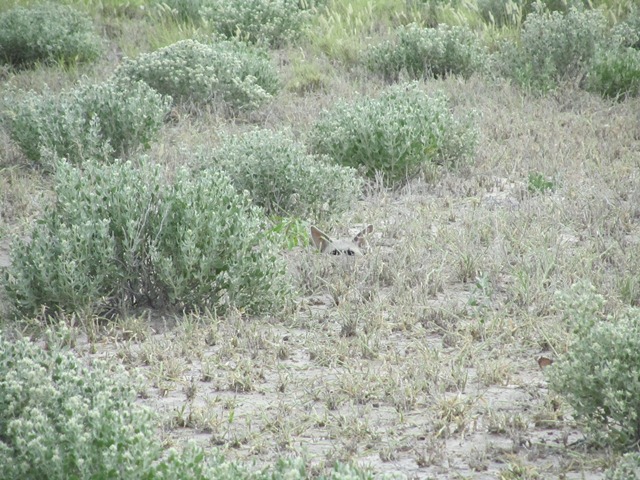
One day we are entertained by the curiosity of an aardwolf in the Central Kalahari whom I happen to catch a glimpse of as he pops his head out of his den looking like Yoda from Star Wars. Head pops up, he takes a quick look around, head goes back down. As a nocturnal creature he should be sleeping in preparation for his nightly feast of insects but this particular day he’s too curious to sleep.

Then next day we are following a pack of nine wild dogs as they kill an impala. As one takes off in hot pursuit of its next meal, the others follow, on the job training so to speak for the five young pups. We miss the actual kill (fortunately, don’t really need to see the cute defenseless impala killed) but manage to see the pursuit and the feast after the fact. The pups are allowed to eat first, while the four adults wait in the wings. The pups chirp and tweet as they pull at what remains of the carcass. We wonder if these pups might be the off spring of the pregnant dog we saw in this same area back in July. They would be about the right age. When they are finished, nothing remains of their young victim. They seek shade with full bellies for an afternoon nap.

Wild dogs in Khwai River Area

Wild Dogs on the Kill

Baby Impala (not the victim of the kill)
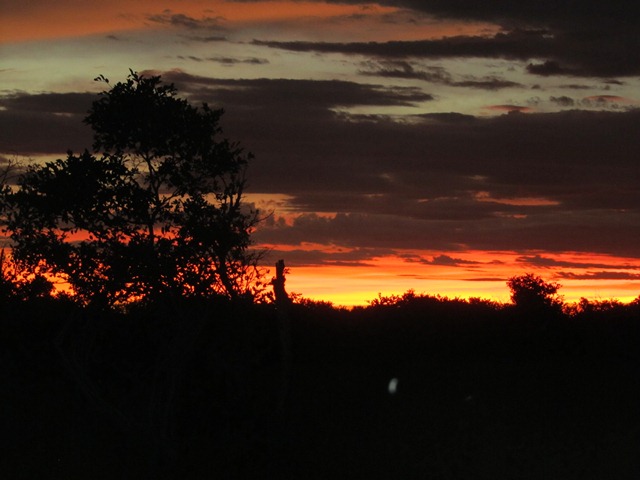
Our days end with the ritual of “sundowners” where a nice glass of wine greets a beautiful African sunset which never fail to cause one to stop and reflect on the highlights of the day and appreciate all that one has been so lucky to see. 

Sunset at Khwai River

Sunset in Savute

Monday, January 14, 2013

Travel Adventures over Christmas and New Years


Heads pop up from a series of holes in the ground as we wait patiently, sitting on the opposite side of the dirt track, for the meerkats to get comfortable with our presence and reappear. We’ve spotted them on our drive through a section of the Transfrontier Park which spans the south western corner of Botswana into South Africa. The longer we stay with them, the more they resume their normal patrol activities. There are a dozen or so curious little critters that stand on the side of lumps of earth, high on their toes to get a better vantage point, arms hang lifeless by their side, eyes darting to scan the area. Others scurry around from one hole to the next, sticking close to their comrades for security in numbers as they sneak a peek at us across the way. One even rests back on his butt while he takes his shift as “look out”. It’s like our own little “meerkat manor”. Just one of the many adventures we’ve had over our two weeks of holiday travel around Christmas 2012 and New Year’s 2013. 


Paul and the "Kalahari Christmas Tree"


 It is these small encounters that we enjoy the most when traveling in the bush. On another day in the Western Kalahari we settle down to watch and photograph a flock of masked weavers build their nests. The tree they’ve settled in looks like a “Kalahari Christmas tree” with the many nests resembling ornaments on a Christmas tree. Multiple males build their nests while one female looks on as if she’s supervising the construction. Perhaps she’s selecting her mate as well as her new home? The task of weaving is impressive as the birds grasp separate twigs with each foot and weave the single blade of grass they’ve arrived with joining the branches into a circular loop. A full nest must take them days to complete. These are certainly “nests built to impress.” Males hang from their feet upside down inspecting their handiwork. The chirping sound of the multiple birds busy at work only adds to the magic of the experience.


Paul photographing storm right before he got zapped!
The weather varies between what I like to call “hot as Hades” (reaching well over 100 degrees Fahrenheit on a daily basis) to electrifying, as massive storms brew in the sky unleashing the most spectacular lightning displays. With no mountains to break the sound, you can hear these weather events rumble in from afar. During one such storm at the edge of the Makgadikgadi Pans near the Nata Bird Sanctuary, Paul jumps out of the safety of our vehicle to get a better shot. One deafening crack of thunder sends him fleeing back to the Pajero, eyes as big as saucers, as he experiences a slight zap from a blade of grass that touches his leg conducting the electricity from a bolt of lightning that has hit the ground. We watch the rest of the storm from inside the vehicle as the wind sweeps the sands of the pan up to the sky in what looks like the reversal of rain, as the earth rises to the sky as opposed to the skies pouring down to earth. After the storm, our campsite at the edge of the pan transforms into water front property as our view looks more like a glance at the setting sun over the ocean than a dry clay flat area with a slight rise at the edge (hence the name “pan”). 

Storms a brewin'

Pan sand swept up in storm.
Sunset over the pan, after the storm


Zebra Migration Makgadikgadi Pans
The heat of the day is filled with magazine and Kindle reading, checking out birds we’ve seen in the bird book - like the marvelous woodland kingfishers we saw in abundance at Molema camp in the Tuli Block that were, unfortunately, too quick to capture on film, their shock of turquoise wings flying between the tall nyala berry trees so untypical of the rest of Botswana – and basically trying to stay as cool as possible in the sweltering mid-day sun. If we’re lucky we can find two trees from which to hang our double hammock and seek some shade. On Christmas Eve Paul is serenaded with the lyrics of all the Christmas songs I can think of in hopes of, at least mentally, transporting us to a winter wonder land. The difficult to describe braying of zebras only serves as the backup chorus from the migration of zillions of zebra to Makgadikgadi Pans. One can see zebras as far as the eye can see and this only adds to the beauty of our isolation in the pans where we only see one other vehicle in two days. It is simply us, the zebras and an occasional flock of flamingos wading in a pan trying to stay cool.


Campsite at Tree Island
Flamingos in pan
 Our adventure is not without excitement. I learned a couple of important things on our most recent travels. First, I learned why puff adders are called “puff” adders. As we’re packing up our camp at Tree Island I hear a distinct “huff” as I carry some boxes to load into the Pajero. I look down and straight ahead of me I see a sand colored twelve inch snake recoil and rear up and let out his “puff”. It certainly got my attention as I ran to the other side of the vehicle to tell Paul, “Snake!” He laughed after the fact, when recounting that I then immediately ran back to the snake to take a better look at him (and keep an eye on him to make sure he didn’t slither into any of the things we were packing into the vehicle). Unfortunately, in our fascination with watching him make his way to the base of a tree where he used his multi-color pattern to blend in with the bark and continued to huff and puff for several minutes quite agitated, we failed to get a picture of him. While he was just a young adder (they can grow quite long) this was actually NOT good news as the juveniles don’t have complete control of their venom distribution and tend to dump all the venom they have into their victim. As one of the deadliest snakes in Africa, it is a good thing he has an early warning system (and that I jump and run fast).


Mom and baby rhino at Khama Rhino Sanctuary

We also saw scorpions galore on this trip. The first was a rather large (six inch) yellow fellow who crawled out of our ground cloth as we packed up our tent after a night of camping at Khama Rhino Sanctuary. Raising his pinchers like lobster claws he curled up this stinging tail and made a quick exit in the morning light. Sends chills up my spine just thinking about it! We saw even more when we joined a group of campers in the Western Kalahari for a night of strategizing on how best to assist local communities that once benefited from hunting in their areas, once hunting officially ends in 2014. These communities used to be paid a fee by the hunting sector for each of the animals they were allowed to hunt in their area. The communities could then use those funds for community needs. With hunting ending in 2014 (on a mandate from the President), these communities now face the challenge of what to do  to generate income in their area.


Our scorpion viewing was facilitated one night by a “black light” torch (flashlight) that a friend had. The special light causes the potential hazards to luminesce all over the ground like neon signs. Sometimes I think you’re better off not knowing what’s out there in the dark that you can’t see. With my new awareness of all the stingers out there, I didn’t sleep much that night. This was especially true after noticing a rather large fellow about a foot away from where I had just peed! Yikes! Needless to say, I did not leave the tent that night. To make things worse, I found another scorpion on the bottom of my exercise mat inside the house last week. If this is starting to become a trend, I’d like it to finish soon…

Finally, I had my first encounter with a “blister beetle.” As you can guess, this nasty little insect gets his name from the acid he admits from his legs that causes skin to blister and burn like hell. On Christmas Eve I started to develop a little burning in the corner of my left eye. When I woke up Christmas morning the eye was starting to swell and the entire lid was burning (as if on fire!). By Boxing Day (the day after Christmas) I could hardly see out of the eye, due to the swelling, and it was almost purple with inflammation. Unfortunately, even though we were transiting through Francistown that day, a relatively large town in Botswana, I couldn’t seek medical attention (even though I desperately wanted to) because nothing was open on “Boxing Day” (who knew?). My best course of action was a wet wash cloth and a frozen bag of peas I picked up at a grocery store. Paul also bought me an orange/mango Popsicle at a petrol station which improved my mood and sent me in to rounds of song like, “All we can say, is give “peas” a chance” and a variety of other songs with the word “peace” substituted with “peas.” I may have been delirious with pain at that point…

While we’re not really sure if a blister beetle was the cause of the eye trauma (we never actually saw the perpetrator), we suspect it was because, at about the same time as the eye issue I developed a large set of blisters on the back of my right knee. Since the redness in the back of my knee and peeling of my eye lid continued for two weeks after, we’re pretty sure a blister beetle was to blame. Note to self: don’t touch your eye after swiping something off the back of your knee.

Given the long distances in Botswana, our trip from Makgadikgadi Pans to Nata Bird Sanctuary to far eastern edge of the country in the Tuli Block on the Limpopo River to Khama Rhino Sanctuary and then back to Maun one week, followed up with our trip to the south western part of the country through Ghanzi to Transfronteir Park with a night of bush camping in between (where you literally pull off the side of the dirt road you are on and camp in the bush) and then a couple of nights out in the Western Kalahari included many long drives on roads that look like this:

Road in Mkgadikgadi Pan


…and unique vistas of rolling sand dunes, open pans with hartebeest, eland and springbok and many, many steenbok (or what are called "phuduhudu" – which is more fun to say). Phuduhudu are some of the smallest antelopes in the area. They mate for life and are often seen within a short distance from their mate. They are hardy souls and can be found in the most barren areas of Botswana. They run like lightening, sprinting out of view, only to stop and turn to have a look at you as you drive by.

Me checking out the view at the Limpopo River

Full moon over the Limpopo
View of Pan in Western Kalahari

In short, we had a nice escape from the office for almost two week over the holidays. Hope you've enjoyed reading this and had a little escape as well!

The End